Home
Custom furniture from AI designs: factories and workshops
Three manufacturing paths for a Claude Code furniture concept: Foshan factories, SendCutSend-style metal cutting, and local EU workshops.
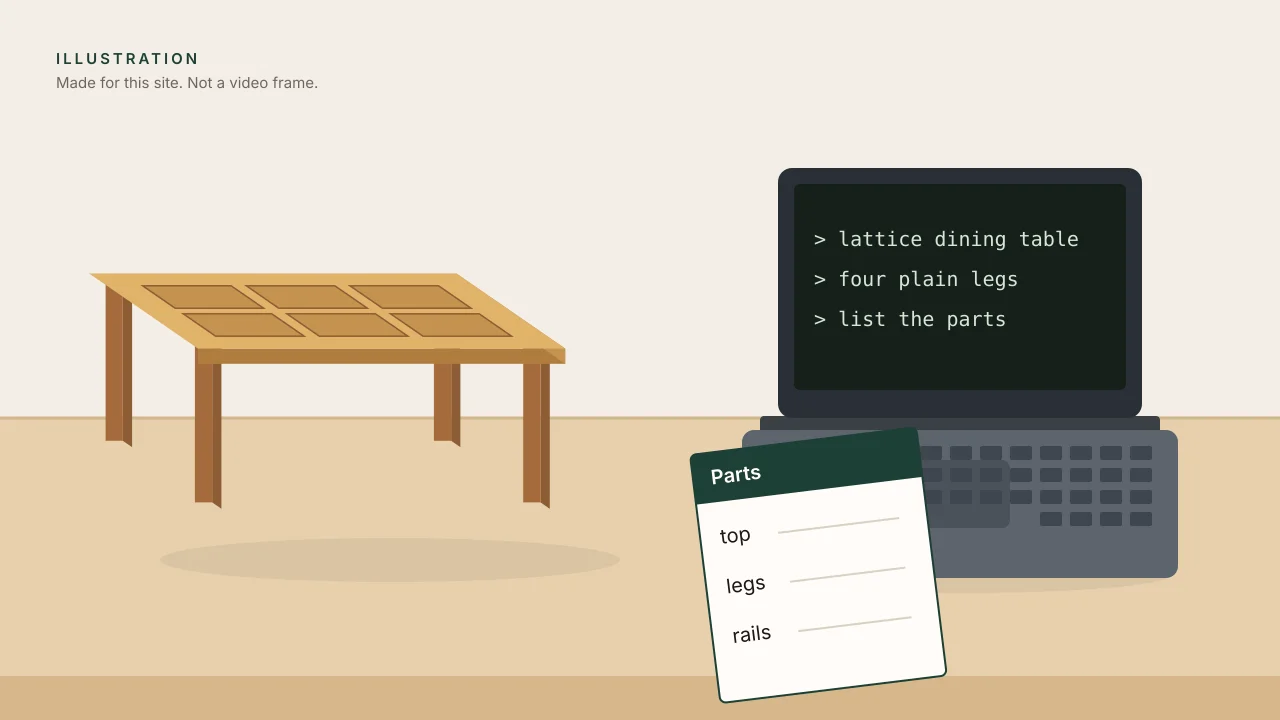
On 7 November, Pieter Levels credited Anna Lux (@theannalux) with designing a dining table using Claude Code. The video shows a local HTML “Mesa de Jantar” preview: a furniture concept that now needs a manufacturer.
There are three distinct routes from that screen to a physical piece: a Foshan furniture factory, a SendCutSend-style parts service, or a local EU workshop. The choice depends on whether the job is a complete custom build, a set of components or a repeat production order.
Scope and safety: This is an independent summary of public material and published manufacturing services. Suppliers describe their own capabilities; none has agreed to make this table. Savings are unverified claims, not checked quotations. Furniture that supports people or substantial loads needs structural and material review: this is not a how-to or a structural sign-off. No order was placed for this article. Mentioning a person, brand or supplier implies no endorsement, and this is not a guide to importing from an unnamed factory.
Three paths, three different purchases
| Path | What it could cover | What the supplier needs | Main limitation |
|---|---|---|---|
| Foshan / Shunde factory | A complete custom piece or a coordinated furniture program | Drawings, quantities, materials, finishes, construction details and export requirements | The showroom seller may not be the manufacturer; sampling, QC and landed costs need agreement |
| SendCutSend-style bureau | Metal brackets, plates, flat-profile legs or frame components, with selected secondary operations | Cut-ready CAD, material and thickness, plus bend or finishing details | Components are not a finished wooden table; SendCutSend ships only to the US and Canada |
| Local EU workshop | A complete bespoke table, joinery project or small batch; a CNC shop may supply components | A dimensioned brief or drawings, developed and approved with the maker | Scope and availability vary; we have not compared prices |
1. Foshan: finding the right kind of factory
Foshan is a city, Shunde is one of its districts, and Lecong is a furniture trading center within Shunde. GDToday’s October 2025 report, sourced to Nanfang News Network, places Lecong Furniture City in the Pearl River Delta and traces its origins to the 1980s.
The report describes more than 180 furniture malls, over 4 million square metres of operational area, and more than 10,000 distributors and 3,000 manufacturers from China and abroad. That mix is what makes the cluster useful: it brings manufacturers, showrooms and distributors together, rather than offering one uniform factory service.
Louvre belongs to the showroom side of this picture. The same report describes its exhibition-center and headquarters complex as bringing together domestic and imported furnishing brands. Across Lecong’s wholesale and retail markets, it lists solid-wood, panel-type, dining, sofa and hotel furniture.
Buying a displayed piece is different from commissioning a new design. A showroom seller may offer floor stock, catalog orders or custom work. A trading company or sourcing agent may coordinate several suppliers without owning the production line. The European Commission’s import guide makes the same basic distinction between buying directly from a producer and importing through a distributor. Knowing who makes the furniture—and who is responsible for it—is more useful than a “factory-direct” label.
Match the workshop to the materials
A wooden table points towards a woodworking or panel-furniture manufacturer. Metal legs or frames bring in fabrication and finishing, while chairs and sofas add upholstery. Glass or stone tops introduce another question: will the main supplier make them or buy them from a specialist processor? The published examples show these material combinations, but do not establish the component supply chain for Anna’s table.
Youmu Shiguang advertises furniture made from buyers’ drawings, samples, specifications or concepts. Its restaurant-furniture page lists solid-wood, hardware and panel-furniture factories, with a contact address in Lecong, Shunde. One listed combination pairs a metal-legged, sintered-stone table with solid-wood upholstered chairs. This is the kind of mixed-material coordination a furniture order can involve.
Baotian, a self-described Shunde manufacturer and exporter, offers OEM/ODM furniture for hotels, retailers, importers and private-label buyers. Its service covers specification review, sampling, production, inspection, packaging and container-loading coordination.
The distinction between OEM and ODM helps define the job. With buyer-design OEM work, production is developed around the buyer’s design and specification. ODM customization starts with the supplier’s designs or collections. Momoda’s Foshan bespoke service offers both approaches. Changing a catalog table’s finish is a smaller design task than developing a new lattice structure from scratch.
Supplier video: “Inside a Premium Hotel Furniture Factory — DUGAO Furniture Foshan 🏨🪵”, by Guangdong Dugao Furniture Co., Ltd. The channel presents its promotional video as a tour of its Foshan hotel-furniture factory; it is not an independent inspection.
From drawings to an agreed order
The published services follow a broadly similar path:
Design packet → request for quotation → technical review and quote → sample or prototype → revisions and approval → agreed deposit → production → QC → export packing and delivery.
Each stage resolves something the initial image leaves open. Youmu Shiguang describes reviewing samples and adjusting them before production. Momoda describes CAD review, sample confirmation and production after sample and deposit approval. Baotian emphasizes approved drawings, material references, packing marks and change records. Sending the design starts that work; it does not replace it.
The delivery basis also matters. Momoda lists FOB Shenzhen/Guangzhou alongside other Incoterms. Under the FOB arrangement explained in the Commission’s import guide, onward transport and other costs sit with the buyer. A factory quote is therefore not necessarily a delivered-to-your-dining-room price.
One table is a different job from a production program
These services largely address hotels, fit-out teams, furniture brands, retailers and importers. Repeated designs, agreed quantities and coordinated shipments suit a different procurement process from furnishing one room. Momoda also advertises single statement pieces within its project offering, so volume is not the only possible route.
An individual buyer may instead deal with a showroom seller or an agent. Either way, the order needs clear responsibility for the specification, inspection and delivery. Minimum order quantities and lead times vary; neither was verified for this design.
Trade fairs show how the wider supply chain fits together. CIFF’s official report on its 2026 Guangzhou edition describes three connected exhibitions: Home Furniture, Office & Commercial Space, and CIFM/interzum for manufacturing and materials. Finished products and the means to manufacture them are separate parts of the same industry.
2. SendCutSend: order the components, not the table
A parts bureau offers a narrower route. Instead of commissioning a complete piece of furniture, the buyer supplies manufacturing files for individual components.
SendCutSend offers laser cutting, waterjet cutting and CNC routing for sheet materials, alongside CNC machining and secondary operations. Its materials include aluminum, mild steel, stainless steel, brass, copper, plastics and Baltic birch plywood. Finishing options include deburring, powder coating, anodizing and plating, depending on the material and service.
For furniture, this could cover mounting plates, brackets, flat-profile legs or frame components within its design and size limits. Bending and hardware insertion can turn a flat profile into a more useful component. Joining those parts to timber, coordinating a complete base and checking the finished structure remain separate jobs.
Its upload formats include DXF, DWG, AI and EPS for 2D work, and STEP/STP for suitable 3D work. The company’s Fusion export guidance explains the difference between an assembled model and a flat-pattern manufacturing file, including checks on units and exported geometry. An interactive HTML preview is not a cut file.
Nor does a plywood option make this a complete bespoke wooden-table service. The demonstrated three-metre muxarabi table also needs timber construction, glass and assembly; upholstery is outside this parts-making route.
For European readers, the geographical limit is straightforward: SendCutSend’s shipping FAQ says it ships only to the US and Canada, with no exceptions for other countries. It illustrates the file-to-part model, but is not a direct EU-delivery option.
Official tutorial: “How to Export a Flat Pattern as DXF in Fusion 360 for Laser Cutting”, by SendCutSend. Their video and accompanying article cover flat-pattern export and geometry checks, rather than a furniture build.
There are EU services using the same model. Cutworks, based in Bavaria, advertises steel, stainless-steel and aluminum cutting from uploaded designs. It names Belgium, the Netherlands, Austria and Luxembourg among its delivery markets. Its CAD requirements accept DXF, EPS and STEP, distinguish 2D cut contours from 3D bending models, and exclude assemblies as STEP parts. Like SendCutSend, this is a component supplier rather than a replacement for the furniture maker.
3. Local EU workshops: commission a complete piece
For a one-off dining table or a small batch, a local joiner, cabinet maker, metal-and-wood workshop or contract-furniture maker offers another route. Working nearby can make design discussions, material samples and inspection visits easier. A locally built and delivered table also avoids the finished piece’s ocean-freight journey from China, though its raw materials may still come from elsewhere.
Sturdy Legs in Emmeloord, the Netherlands, describes a process that starts with a sketch, photograph or description. It develops the drawings and combines wood and steel in its workshop, with applications spanning hospitality, retail, offices and homes. Here, the commission is for a finished piece rather than a set of cut profiles.
A CNC shop can take a different role. CNC Maatwerken in Wijk bij Duurstede says it mills wood and plastics from customer drawings and specifications, supplies furniture makers, and supports custom furniture design and assembly. It lists single pieces, prototypes and series work for private and business clients. The scope can therefore range from a component to a wider build; the agreement needs to say who finishes and assembles it.
Custom manufacturing need not mean a container program or a trip abroad. These workshop services make a local commission a practical option to explore. We obtained no comparable quotes, so there is no verified EU-versus-China price comparison here.
For goods moving within the EU customs territory, the Commission confirms there are no customs duties between Member States. VAT still applies: Your Europe’s consumer guidance explains that cross-border online sales can use destination VAT. Product and timber rules also remain part of the job, even when the maker is nearby.
What the Claude Code preview still needs
The table’s sidebar specifies 300 × 110 × 75 cm, 10 seats, 10 mm extra-clear glass over a wooden grate, and a painel vazado 10 × 10 cm lattice, which Anna calls a muxarabi. Glass is specified, but is not visibly rendered in the recorded view of the wooden grid.
Material toggles read Cumaru, Pinus, Carvalho and Freixo, and Aço 304-L / Aço corten. “Separar peças” separates the top and legs while the chairs vanish. No tabulated bill of materials appears on screen. The preview communicates shape and options, but a supplier still needs the selected materials and a quantities schedule.
Whichever manufacturing route is chosen, the handoff needs four things:
- Dimensioned drawings and quantities: overall and component sizes, units, part identifiers and quantities.
- Materials and finishes: selected timber or panel specifications, metal grade, glass requirements, finish samples and agreed substitutions.
- Construction and tolerances: hardware, joinery, connection details, fits and competent review of stability and loads. Changing a material can change the engineering as well as the appearance.
- Use, destination and packing: domestic or contract use, applicable safety and emissions requirements, assembly responsibilities, protective packing and acceptance criteria.
That is the work between a convincing preview and a design a manufacturer can quote and produce. The HTML model is a starting brief, not a manufacturing drawing set.
The quote, the delivered order and the rules
The appeal of going straight to a maker is partly financial: in his original post, Levels claimed 85% savings against premium brands such as Poliform, with a $30,000 sofa becoming $4,500 and an $8,000 table becoming $1,200—unverified examples, not factory quotations.
A useful comparison needs to cover the same finished result. That includes the specification, inspection, packing, transport and any import charges, not just the cost of making the parts.
Quality control connects the sample to the delivered order. A showroom piece or approved prototype establishes a reference; production still needs checking against it. Renaud Anjoran’s inspection explanation covers specifications, dimensions, labels, packing and approved samples. His reference-sample discussion also addresses the difficulty of sending whole furniture pieces for comparison.
Import costs depend on the product and delivery agreement. The Commission’s import guide explains that tariffs may apply and VAT applies to goods imported into the EU. We have not calculated freight, duties, tax or a landed price for this table.
Timber and emissions requirements follow the product, too. The Commission’s EUTR guidance covers timber-legality due diligence. Its EUDR page explains the successor framework, product scope and phased application dates. The applicable obligations depend on the product, operator and timing. EU Regulation 2023/1464 addresses formaldehyde releases from furniture and wood-based articles, including concerns associated with resins in composite wood. These are general compliance considerations, not findings about the suppliers mentioned here.
The route from AI design to furniture is concept → reviewed specification → the right maker → an inspected result. Foshan factories, cut-parts services and EU workshops each handle a different part of that journey. Choosing between them starts with deciding what needs to be made—and who will take responsibility for the complete piece.
For smaller projects, the AI-to-print guide and process comparison explain other file-to-manufacturing handoffs. The cost report keeps reported bills separate from quotes.
FAQ
Who could take a custom furniture order from an AI design?
A contract furniture factory, a local joiner or furniture maker, or a specialist parts bureau could review different parts of the job. Published Foshan OEM/ODM services and EU workshops accept drawings or specifications, but none has agreed to manufacture Anna Lux's table. An HTML preview is a starting brief, not a production drawing set.
Can SendCutSend make the whole table and ship it to Europe?
Its published services include sheet cutting, bending, machining and finishing, which could suit appropriately designed metal components. We found no complete bespoke wooden table or upholstery service. Its shipping page currently says US and Canada only, with no exceptions for other countries; it is not a direct EU-delivery option.
What would a factory need beyond the preview?
Dimensioned drawings, quantities, agreed materials and finishes, hardware and joinery details, tolerances, destination requirements and packing specifications. Cut-part services need suitable manufacturing files, such as DXF for flat profiles, rather than the interactive HTML page. Structural questions still require competent review.
Were the savings verified, or was anything ordered or built?
No. The savings discussed are Pieter Levels' unverified comparisons, not quotes we obtained. The public demonstration shows a local browser preview, not manufacturing, an order, shipping or a finished physical table. No factory order was placed for this article.
Is this article endorsed by the people or suppliers mentioned?
No. This independent report implies no affiliation with or endorsement by Pieter Levels, Anna Lux, Anthropic, Poliform, Louvre, SendCutSend, any workshop or any factory. Supplier pages describe their own advertised services; they are not independent capability audits.