Workshop
Print it, laser-cut it, or order a PCB? How to choose
A decision guide for vibe manufacturing: 3D print an STL, order a DXF in metal, or send a small board to a PCB fab. When each one wins.
Sources: figures and project summaries already on this site, which trace to Business Insider’s vibe-manufacturing feature. This is a decision guide, not a hands-on test of those parts. Nobody named here has reviewed or endorsed it.
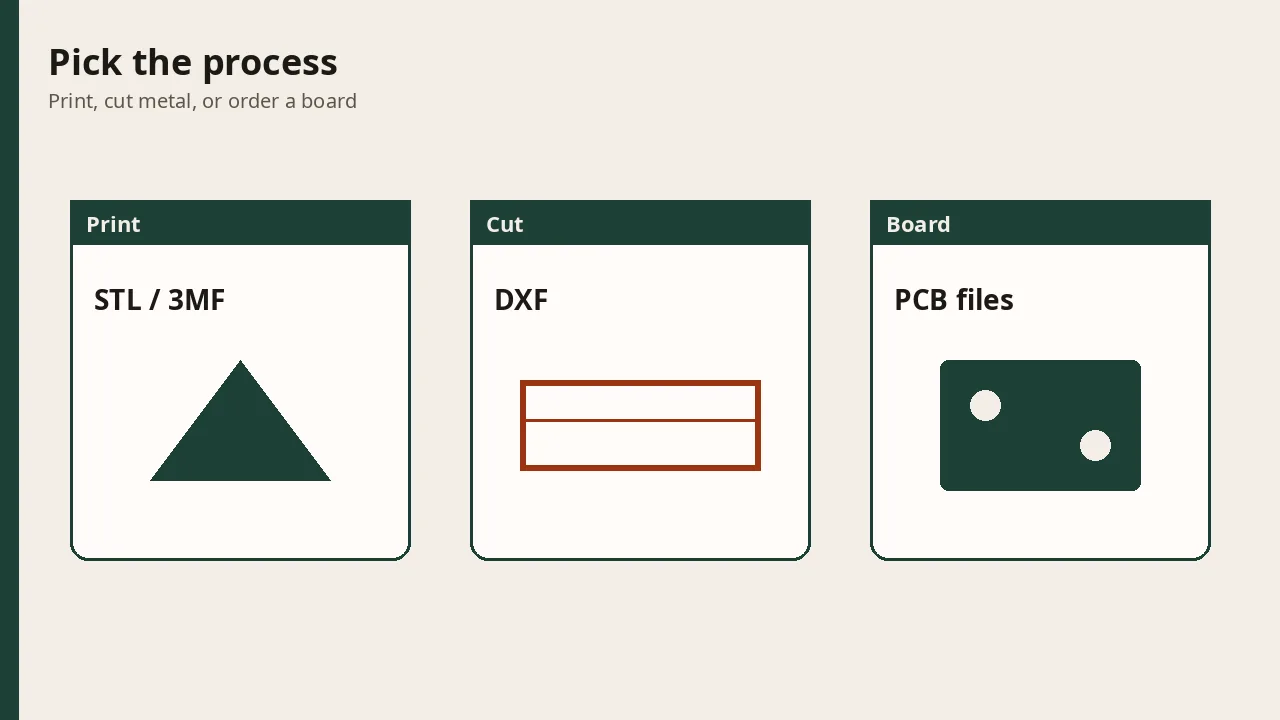
Vibe manufacturing is one loop and three different machines. The topic hubs split them: 3D printing, laser and sheet metal, and PCB and electronics.
The choice in one table
| 3D print | Laser or sheet metal | Small PCB order | |
|---|---|---|---|
| File | STL or 3MF | DXF | Gerbers or a board project |
| Typical parts | Clips, knobs, brackets, enclosures | Flat or bent plates, stiff brackets, stands | Buttons, toys with electronics, small batches of a circuit |
| Where it happens | Your printer, or a print farm | A laser shop or a sheet-metal shop | A board house |
| Reported money | A small PLA test “usually costs very little in filament” on our how-to. No dollar amount is invented here. | $156 for Jeff Deehan’s steel camper bracket. About $200 for Jake Fitzgerald’s sheet-metal robot arm. Both as reported by Business Insider. | About €500 for ten units of Arthur Prince’s story-toy boards, same reporting. |
| When it loses | The part must be a thin, stiff plate, or it carries a person, a heavy overhead load, mains, or fuel. | The shape is bulky, or you need one copy this afternoon and you already own a printer. | There is no circuit. A plastic clip is not a board. |
Print it
Use a printer for a part you can hold, measure, and reprint. The how-to is the workflow. The first-print tips are the checklist. If the file is a figurine or a soft shape, a mesh tool may fit better than code CAD. The text-to-CAD comparison sorts that.
Printed plastic is a poor stand-in for a steel bracket that has to stay straight, and a poor stand-in for a circuit.
Cut it
A DXF is a drawing of a flat outline. AI to DXF is the guide. Business Insider reported Jeff Deehan’s voice-described steel camper bracket at $156 from SendCutSend, and Jake Fitzgerald’s sheet-metal robot arm at about $200 after earlier tries failed. Those are reported bills for those jobs, not a price list. Read the shop’s current rules and get a quote. Our cost guide keeps the same figures in one place.
Laser-cut plastic stands and bent brackets live on the laser hub. They are the wrong process for a geared clip or a board with traces.
Order the board
When the product is electronics, the file is a PCB. Arthur Prince’s children’s story toy, ten units from JLCPCB for about €500, is the Business Insider example already used on the desk mute-button guide. That guide is the beginner path: a low-voltage board, files you can open, a design-rule check, then a small order. A printed case can follow, from the real board, not from a render.
Do not send mains wiring through this loop. The mute-button article keeps that limit.
Three reported jobs, three processes
These are the examples already written up from Business Insider. They are not a menu of prices.
- Print, then keep iterating. David Plakon, in that same reporting, printed an answering-box case about fifteen times. A plastic enclosure is a printer job. The failure guide is what those reprints are usually about. The tips checklist is how to make the next one smaller.
- Cut steel. Deehan’s camper bracket and Fitzgerald’s robot arm were sheet metal, so the file was a DXF and the vendor was a shop. A printer would have made a different, weaker object. Stay on the laser and sheet-metal hub for that class of part.
- Order boards. Prince’s story toy needed a manufactured circuit, ten units, so the file went to a board house. The plastic around a finished board can still be printed later. Stay on the PCB hub when traces are the product.
If you are unsure, write one sentence: “the part has to fit and can be reprinted” (print), “the part is a flat stiff plate” (DXF), or “the part is a circuit” (PCB). Then open the matching guide.
Safety, in one place
Whichever process you pick, stop if the part holds a person, a heavy load overhead, mains electricity, or fuel. An AI file does not add a rating. Buy the hardware that was built for that job, or hire someone who signs the work.
If you are choosing a machine at home rather than a process for one part, the printer page is separate from this table. A printer purchase is not the cost of a clip.
FAQ
Should I 3D print or laser-cut a bracket?
Print it when the shape is chunky, the load is light, and you can test the fit at home. Order sheet metal when you need a flat, stiff part in steel or aluminium and you have a DXF the shop can cut.
When is a PCB the right process?
When the object is a circuit: a button, a toy with electronics, a board that has to be manufactured in a small batch. A printed case can still go around that board.
What file does each process want?
3D printing wants an STL or 3MF. Laser and sheet metal want a DXF. A board house wants Gerbers or a PCB project. Mixing those up is how files get rejected.
Are the dollar figures on this page quotes?
No. They are figures Business Insider reported for named projects. Shop prices change. Ask for a current quote.