Home
A Codex-designed magnetic stabilizer pad for a foldable phone
Charlie Chapman had Codex design a 3D-printed pad that holds a foldable phone flat on a MagSafe puck for drawing. What it does, how it was made, and how to print one.
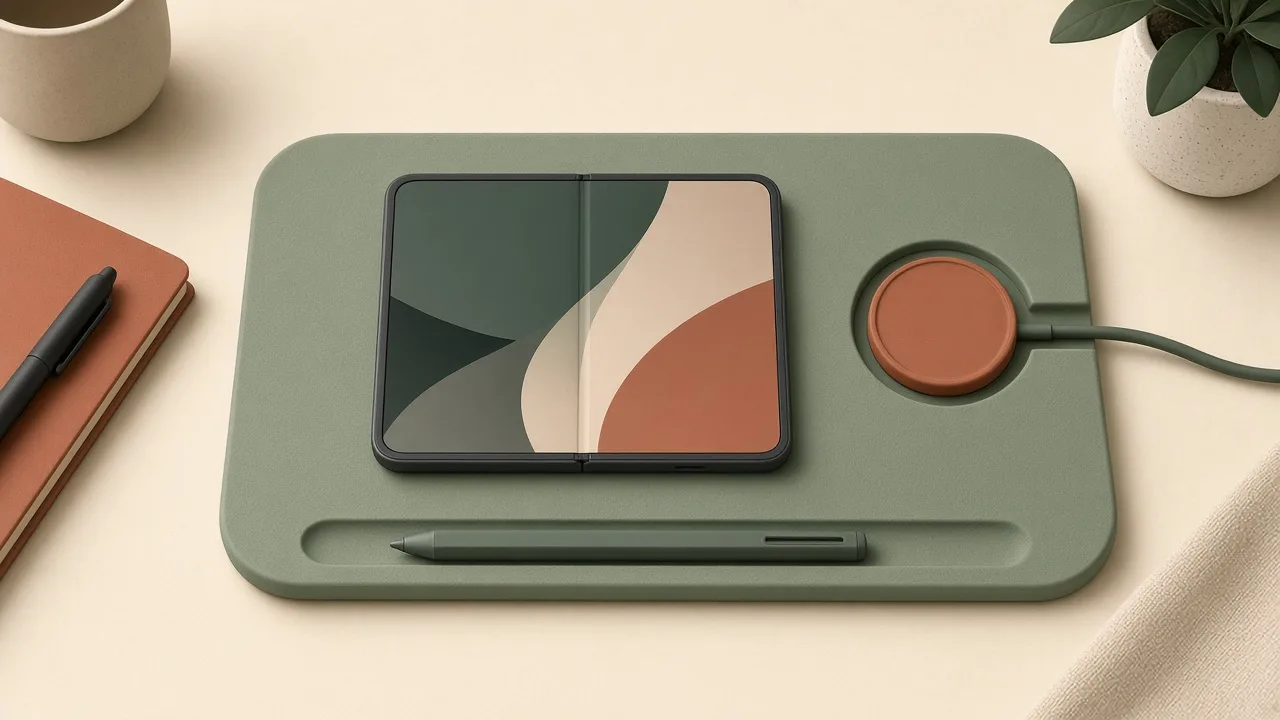
Source: Charlie Chapman (@_chuckyc) on X, November 4, 2026, and the model page iPhone Duo Magnetic Stabilizer Pad on MakerWorld. This is an independent summary; the creator, Apple and OpenAI have not reviewed or endorsed it.
Charlie Chapman draws in Procreate on the inner screen of his foldable iPhone Duo. Lying flat on a table, the phone wobbles. So, in his words, “I (ok Codex 🤪) whipped up a little 3d printed stand.” It’s a small, practical example of vibe manufacturing: a coding agent writes the design, a home printer makes it, and the file goes online for others to print.
The problem
A folded-open phone is thin and doesn’t sit evenly on a hard surface. Pressing on it with a stylus makes it rock. A pad that holds the phone flat with a magnet fixes the wobble and charges it at the same time.
What was made
From the model page:
- A low-profile pad with a cutout and a cable channel for a MagSafe or third-party magnetic puck. The puck holds the phone in place and charges it.
- A low rounded frame, relief for the camera and the cable, and storage for the Pencil.
- Holes in the bottom, which he says in a reply are “Just to take less material / ventilation.”
- Alternate puck fits. He tested it with his 56 mm third-party puck. Other versions match the published diameter of Apple’s MagSafe chargers.
The model is a remix of “iPhone Duo 垫板” by HTX_Studio, shared under a BY-NC-SA licence. We are not reproducing the photos from the post; see the original post for them.
Print settings
The MakerWorld page lists one plate at 0.16 mm layer height, 2 walls and 15% infill. It takes about 2.2 hours and 51 g of PLA.
Workflow for your own device pad
These steps are our general advice for a similar pad for another phone or tablet. They are not the creator’s exact process.
1. Describe the problem, not just the shape
Tell the AI what goes wrong: “the phone rocks when I draw on it.” That leads to a better design than “make a stand.”
2. Measure the puck and the device
Measure the puck’s diameter and thickness, the cable exit, the device’s footprint, and the camera bump. Write them in millimeters.
3. Prompt for a CAD model
Write OpenSCAD for a low-profile pad that holds a phone flat on a
magnetic charging puck. Puck: 56 mm diameter, 6 mm thick, cable exits
on one side. Phone footprint: W x L mm, camera bump at the top left.
Add a cable channel, camera relief, a stylus groove along one long edge,
rounded corners, and 0.3 mm clearance around the puck.
Swap in your own numbers. The 6 mm thickness above is a placeholder.
4. Print a thin test ring
Print just the puck pocket as a thin ring first. A pocket that is too tight can crack; one that is too loose lets the puck spin.
5. Add the details last
Once the fit is right, add the stylus slot, cable channel and lightening holes.
Cost and time
Estimate, not a quote. The published print uses 51 g of PLA and about 2.2 hours of print time. Filament for that is a few euros at typical prices. The magnetic puck costs extra if you don’t own one.
Pitfalls
- Puck sizes vary. Third-party pucks differ from Apple’s. Measure yours.
- Heat. Charging warms the puck. Leave airflow, and avoid thin walls right next to it.
- Licence. The remix is non-commercial. Don’t sell prints of it.
Small fitted parts like this are a good first project. See also the dishwasher rack tine clip, French cleat holders for odd tools, and our guide on how to make a 3D-printable part with AI.
Tools and services
- Codex, which the creator says designed the pad.
- MakerWorld, where the model is published.
- Calipers, a slicer, and a 3D printer.
Related use cases
FAQ
What is this pad for?
It holds a foldable phone flat and steady on a magnetic charging puck, so the inner screen doesn't wobble while you draw on it. It also has a slot to store a stylus.
Who made it, and how?
Charlie Chapman (@_chuckyc) says on X that he had Codex design it. He published the model on MakerWorld as a remix of an earlier pad by HTX_Studio.
Will it fit my charging puck?
The creator tested it with his 56 mm third-party puck and offers versions sized for Apple's published MagSafe charger diameter. Measure your own puck before printing.
Can I sell prints of this model?
The MakerWorld page lists the model as a remix under a BY-NC-SA licence, which does not allow commercial use. Check the page for the current terms.
Is this article endorsed by the creator, Apple or OpenAI?
No. This is an independent write-up based on the creator's public post and model page. None of them has reviewed or endorsed it.