Repair
Replacement clip for a dishwasher rack tine
Model a replacement tine clip for a discontinued dishwasher rack, test the snap, and read the filament datasheet before you trust the heat.
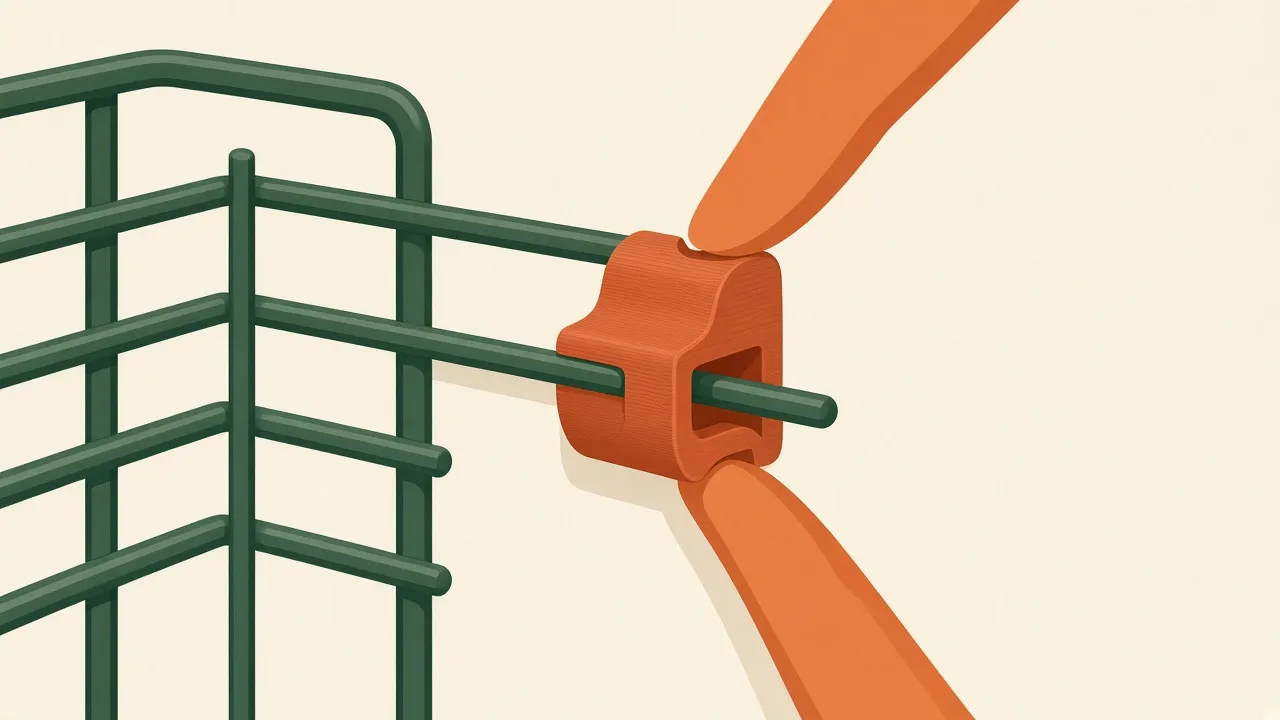
The tine cap snaps off, the coated wire starts to mark glass, and the parts diagram uses a number nobody sells. A replacement clip is a reasonable small print if you treat it as a test fit on a rack, not as a blessing of the whole dishwasher. The machine’s latch, heater, and float are not this project.
This sits inside the broader vibe manufacturing loop, scaled down to a part you can hold with two fingers.
The problem
Dishwasher racks are steel wire with a coating, plus a family of little plastic parts: tine caps, fold-down clips, and adjusters. The one that failed is usually one of these:
- A cap that covered a cut wire end and is now missing, so the end scratches bowls.
- A clip that held a fold-down row and has gone brittle.
- A spacer that kept a stem from falling through.
The maker may still sell the rack or the clip. Search the model number before you open a CAD tool. A generated part is the path for a discontinued rack, or for a clip whose listing has been “unavailable” long enough that you have stopped believing it will return.
You are making a small snap or cap that matches a wire diameter. You are not remanufacturing the rack, bypassing the door latch, or printing a new spray arm. If the dishwasher is leaking, heating badly, or failing to lock, stop and use a real parts channel or a technician. Those faults are how a kitchen flood or a shock starts.
Workflow
1. Measure
Pull the rack. Do not measure from memory of “about 4 mm.”
- Wire diameter, with calipers, on a straight section and near the break. Coating adds thickness. Measure the wire the clip must grab.
- The length of the cap, and whether it is a closed end or a side clip.
- Any neighbor clip that is still intact. That survivor is a better reference than a photo from a listing.
- The row spacing, if the clip also indexes a position.
Write millimeters. Photograph the calipers on the wire. Note the dishwasher model number in the same note so the file does not get reused on a different rack next year.
2. Prompt for a CAD file
Describe the clip as a cap with a slit and a little extra compliance. Ask for an STL.
Model a tine cap for a 4.2 mm diameter coated wire.
The cap is 14 mm long, closed at one end, with a C-shaped cross-section
that snaps over the wire. Inside diameter 4.3 mm.
Wall thickness 1.6 mm. Add a small internal rib so it does not slide off.
No latch, no electrical part, no full rack.
Export STL in millimeters.
Use the diameter you measured. A 0.2 mm miss is the difference between a cap that falls into the sump and a cap that cracks as you push it on. The study-model cradle has the same unit problem at a larger scale. Here the part is small enough that you will blame the printer first. Check the units anyway.
3. Prototype
Print two. Snap one onto the wire while the rack is out of the machine. It should click on without a tool and stay put when you tug with a finger. If it cracks, do not force a second one. Change the model. If it is so tight you are shaving the coating, it is too tight.
Only then run a dishwasher cycle with the rack otherwise empty, or with cheap dishes you can stand to scratch. Listen for a rattle. Look at the cap when the cycle ends. A cap that survived one cycle has not been proven for a year of detergent and heat. It has earned a longer trial, which is different.
4. Review
Read the filament datasheet for heat. PLA is a weak default inside a dishwasher. People often move to a higher-temperature filament for this kind of clip. “Often” is not a certification. The datasheet’s heat number is not the same thing as a food-contact statement, and a food-contact statement is not the same thing as “safe in this detergent at this temperature.” If that chain of uncertainty bothers you, the honest outcome is to keep looking for the OEM clip or to replace the rack.
Confirm the slicer’s units. A clip that arrives the size of a thimble is a unit error, the same class of mistake as a receiver knob that does not match the shaft.
5. Send it to a fabricator
Your own printer is the whole shop for this part. A print farm works if you send the STL and the material name you actually chose, not “something strong.” Ask which materials they print. Do not ask them to promise dishwasher performance. They are selling a print.
If the OEM part reappears, buy it and keep the STL as a backup you may never need.
Tools and services
- Calipers and the rack, out of the tub.
- The model number of the dishwasher, and a search of the maker’s parts list before you design anything.
- A CAD or text-to-CAD draft that exports STL.
- A printer or a print farm.
- A filament whose datasheet you have actually opened.
Cost and time
Estimate, not a quote. A few grams of filament is cheap. A farm’s minimum and the shipping can cost more than a still-available OEM clip. A planning range of about $5–$25 is a reason to check the parts diagram first, not a price match. If the official clip is a small, in-stock part, buy that.
Estimate, not a schedule. Measuring is an hour if the rack comes out cleanly. A test print is an evening. A second print is normal when the snap is wrong. None of that includes drying the kitchen because a different, unrelated seal failed. Do not bundle this clip into a larger repair you have not diagnosed.
Pitfalls
- Printing the door latch, the float, or anything near the heater because you are “already in CAD.”
- Assuming PLA, or any unnamed “food-safe” filament, survives hot detergent. Read the sheet. Then decide.
- Measuring the bare wire and forgetting the coating, or the reverse.
- A closed cap with no compliance that cracks and leaves a shard in the sump.
- Skipping the OEM search and spending a weekend on a part that was in stock.
- Reusing the STL on a different model year’s rack because the clip “looks the same.”
- Sanding a tight clip down inside the tub. Plastic dust and a drain pump are a bad pair. Fit it on the bench.
FAQ
Is a printed clip food-safe and dishwasher-safe?
Do not assume that. Heat, detergent, and food contact are properties of a specific material and a specific process, and a blog post cannot certify them. Read the filament datasheet, prefer a still-sold OEM clip when it exists, and do not print a part that changes how the machine's safety interlocks work.
What if the official clip is still for sale?
Buy it. A generated clip is the fallback for a rack the maker no longer supports, not a better version of a two-dollar part you can order with the right wire size.
Can I repair the heating element or the latch this way?
No. This article is a tine cap or a small rack clip. It is not a repair for the latch, the float, the heater, or any part that keeps water and electricity apart.
Why did the first clip crack when I snapped it on?
The wire diameter or the undercut was off, or the plastic was too brittle. Measure the wire again, add a little compliance in the model, and try a material the datasheet rates for higher heat than PLA. Still treat the result as a test, not a certified spare.