Workshop
Multi-colour 3D printing: two plates vs AMS vs a tool changer
When to split colours onto separate plates, when an AMS-style swap is enough, and what Bambu Lab states about the H3C tool changer.
Sources: Whitney Enlow’s public posts as summarised on our desk Grok Bot page, Bambu Lab’s 3 November 2026 H3C announcement, the H3C product page, the specs page, the Bambu Studio 2.9.1 release note, and the US store page as fetched on 6 November 2026. This is not a hands-on test and not an endorsement. Bambu Lab has not reviewed it.
Colour on a print is a planning choice, not a default. The 3D printing hub and the software hub collect the related guides. Slicer planning for Bambu machines is in Bambu Studio vs xTool software.
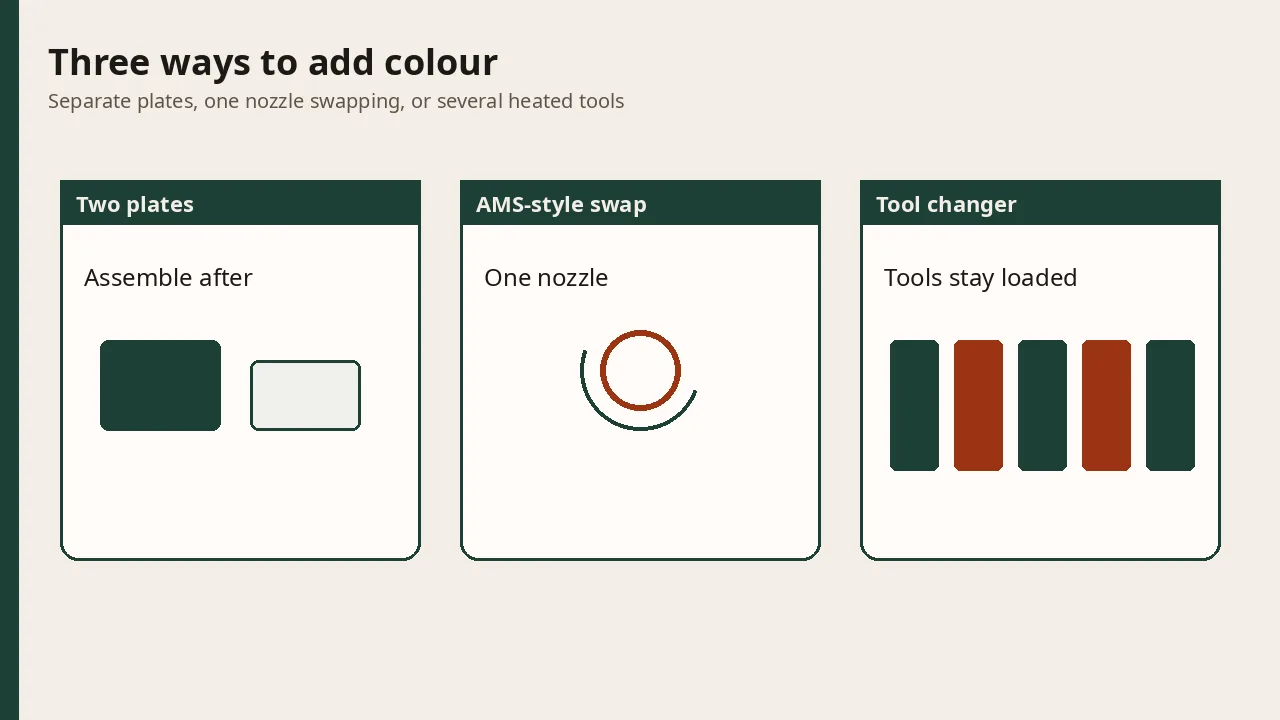
Three ways to get more than one colour
| Path | What you actually do | When it wins | Time and waste | Hardware |
|---|---|---|---|---|
| Separate plates | Each colour is its own plate. You assemble afterwards. | A few parts, a simple two-tone look, no need for colour inside one solid. | No mid-print filament change. Print time is the sum of the plates. | Any single-nozzle printer. |
| AMS-style swaps | One nozzle unloads one filament and loads the next. | Many colours in one solid, and you already own a filament-changing system. | Bambu’s H3C announcement describes each colour change as a cost in time and filament. No purge minutes or grams are quoted here. | A filament system such as an AMS, plus one nozzle. |
| Tool changer (H3C) | Several tools stay loaded. The machine changes tools instead of purging one nozzle through every colour. | Many materials in one job, or different nozzle sizes in one model, if you accept a new machine. | Bambu states a material switch in as little as six seconds in a named internal test. Your slicer and filament can differ. | The H3C, announced 3 November 2026. Extra nozzle diameters are sold separately. |
Two plates: the desk Grok Bot
Whitney Enlow’s desk Grok Bot, free on MakerWorld, is the plain version of this idea. Her post, as summarised on that page, says two plates, about 55 minutes, and zero colour swaps: black body halves on one plate, white pill eyes on the other. You press the eyes in and pin the halves. There is no filament price on that summary beyond a general note that a small PLA print is a few euros. This guide does not add one.
That path fails when the colours have to be interleaved inside one part. Then you need a swap or a tool change.
AMS-style swaps, without invented numbers
On a single-nozzle machine, a second colour means the nozzle lets go of one filament and loads another. Bambu Lab’s H3C announcement describes that older pattern as the remaining hard part of multi-material printing: every colour change costs time and filament. Official pages for the AMS family describe storage, feeding, and slot mapping. They are not restated here as a purge-time table, because this article did not take a purge duration or a purge weight from an AMS specification.
If you already own that hardware, the slicer still has to map each colour to a slot. The Bambu Studio guide above is where that planning lives.
What the H3C pages actually say
Checked on 6 November 2026:
- The announcement is dated 3 November 2026. It describes nine print tools, each with its own filament path and its own heating.
- The product page says a material switch takes as little as six seconds. The footnote says that figure is from internal testing with PLA Basic and a filament-saving purge mode, and that the real time varies with filament and slicer settings.
- The same page says mixed nozzle sizes need extra hotends, sold separately. The Bambu Studio 2.9.1 note says mixed nozzle diameters for different regions of a model are supported on the H3C first.
- The US store showed $2,499 USD on the H3C page, with the H3C Combo as the first bundle in the comparison table, and an on-page line “ETD: Ship around November 30, 2026.” That is a US listing on that date. Other regions can differ. It is not a statement that the printer is in stock everywhere, or that it ships the day you order. EU prices are omitted because they were not checked.
The specs page is the place for build volume, temperatures, and nozzle diameters. Those numbers are not copied into a second spec sheet here.
A store FAQ heading asked whether the H2C would be discontinued. The answer was not in the page text we retrieved, so this article does not say the H2C is discontinued or that it remains on sale.
How to choose
Use two plates for a mascot, a pair of eyes, or a lid in a second colour. Use an AMS-style swap when the colours are woven through one part and you already have the hardware. Look at a tool changer when you want many materials, or more than one nozzle size, in a single job and you are willing to buy a machine that Bambu presents as new. None of these paths removes the fit checks in the how-to or the first-print tips.
Printer context, not a recommendation to buy, is on the printer page.
FAQ
When is printing colours on separate plates enough?
When each colour is its own part that you assemble. The desk Grok Bot example uses a black body on one plate and white eyes on another, with no colour swap during the print.
What is an AMS-style colour change?
Bambu Lab's H3C announcement describes earlier multi-material printing as spending time and filament at each colour change, because one nozzle has to unload one filament and load the next. This article does not quote an AMS purge time or purge weight.
What does Bambu Lab say the H3C changes?
The product page describes nine print tools, each with its own filament path and heater, and says a material switch can take as little as six seconds in internal tests with PLA Basic and a filament-saving purge mode. Actual time depends on material and slicer settings.
Can the H3C use different nozzle sizes in one print?
Bambu Studio 2.9.1 release notes say mixed nozzle diameters are supported on the H3C first. The product page says extra hotends in other diameters are sold separately.
Is this a review of the H3C?
No. It is an independent summary of public pages, not a hands-on test and not an endorsement. We have not printed on an H3C.