Electronics
Claude Fable 5.2 with Diode: three devices, and the limits
An independent summary of Anthropic and Diode's Claude Fable 5.2 demo: three built devices, the Diode PCB Gym scores, and the limits they still state.
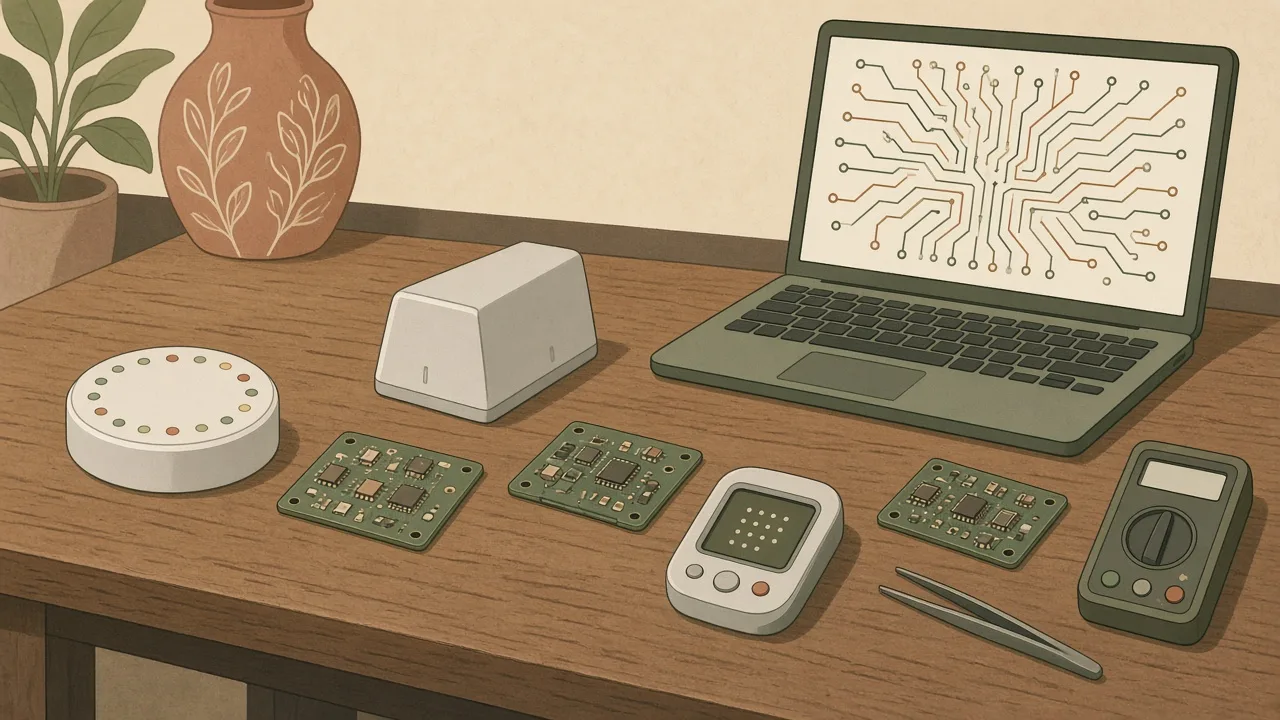
Sources: Anthropic’s research post “Testing Claude on real-world electronics design” and its Claude Fable 5.2 and Mythos 5.2 announcement, both published 9 November 2026, and Diode Computers’ blog post “Teaching Claude to design circuit boards that ship”. We quote briefly and paraphrase the rest. Anthropic discloses a commercial relationship with Diode. Neither company has reviewed or endorsed this article, and the illustration is our own, not a photo of their devices.
Anthropic’s 9 November 2026 research post, “Testing Claude on real-world electronics design”, is a different scale from the small module carriers most often covered on this site. Working with Diode Computers, a PCB design and manufacturing company in the Brooklyn Navy Yard, Anthropic asked Claude Fable 5.2 to design three complete devices from short prompts. That meant the electronics, the 3D-printable enclosures and the firmware.
All three were built and, Anthropic says, worked “without any fixes to their circuitry”.
The three devices
| Device | What Claude had to handle | Status reported |
|---|---|---|
| USB speakerphone | A USB-C puck with microphones, a speaker, Bluetooth with a PCB antenna, a touch wheel and an LED ring | Still working after weeks of use |
| Voice-assistant hub | USB and Ethernet pairs, MEMS microphones, long tracks from a 100-pin connector, a wedge-shaped case | In good working order |
| Handheld virtual pet | Battery power, a charger, a small enclosure | In good working order |
Each has a four-layer board. The prompt for the speakerphone was one sentence: “a puck that plugs into a computer over USB-C and includes microphones and a speaker, supporting Bluetooth with a PCB antenna.”
Video: “Claude Fable 5.2 designs a working voice-assistant hub” by Claude (Anthropic’s YouTube channel), 48 seconds, published 9 November 2026. It is a short showreel without narration.
From prompt to prototype
According to Anthropic, Claude did the following for each device:
- Wrote the specification from the short prompt.
- Drew the schematics and chose parts available from US distributors.
- Placed and routed the four-layer board.
- Modeled a 3D-printable enclosure in CAD and checked that the board fitted.
- Wrote the firmware and prepared the parts list.
- Ran design-for-manufacturing (DFM) and stock checks, then sorted the results into real problems and flags it could ignore.
Each board was ready for manufacturing in under a day, Anthropic says.
What Claude did, and what Diode did
Claude did the design work above. Diode’s team prompted very little. Anthropic lists short directives such as “clean up the schematic” and “continue”, plus a few questions.
Diode supplied the design software, including access to the router built into KiCad, the free PCB design program. It manufactured and assembled the boards, ran the firmware and did the physical build and testing, following Claude’s instructions. Claude wasn’t connected to test equipment or to the machines that make boards. That gap is why people were still needed.
Diode’s own post explains the tooling behind the partnership. It describes circuits in Zener, an open-source language based on Starlark, a subset of Python. Zener renders to KiCad projects and can run SPICE simulations automatically. Diode says a pipeline using Claude drafted about 250 reference designs in two weeks, published at zener.diode.computer. It also stresses that “engineers still sign off every design”.
The details that make it convincing
The write-up is more useful than a showreel because it shows the reasoning behind specific choices:
- Critical routes first. On the hub, Claude routed the USB and Ethernet pairs before anything else, one pair at a time. It matched the lengths and added small zigzags so the signals arrive together.
- Rerouting instead of patching. On the speakerphone, Claude reassigned pins on two chips so the tracks under the touch wheel could stay on one layer. Anthropic says this avoided holes through the touch electrodes. On the hub, it decided the tracks were “getting too tangled to trace visually”, ripped them up and rerouted dozens of times.
- Its own router. KiCad’s router drew one track at a time, which was slow for the hub’s long tracks. Claude wrote a grid-search router in about half an hour, which laid each long track in roughly a second.
- Checking the case in code. A collision check showed the speakerphone board couldn’t be dropped straight into its case, because the mute switch hit the back wall. Claude found it would fit if tilted about 25 degrees, and added that step to the assembly instructions.
- Acoustics. Claude worked out that a 25 mm microphone port would resonate near 3.4 kHz, “right in the voice band”. It changed the hub to a wedge shape, which cut the ports to about 10 mm and moved the resonance to about 8.9 kHz.
- Firmware that protects the hardware. The speakerphone dims its LED ring as the audio gets louder, to stay under the current limit Claude had designed into the board.
- DFM triage. The checks flagged six solder-mask slivers as too thin to manufacture. Claude widened the openings without moving parts. It ignored a flag on a deliberate ground connection, correctly according to Anthropic.
Anthropic also gives benchmark numbers. To show the jump in layout skill, it asked Diode to run Diode PCB Gym, an internal benchmark that scores how well models can place components and reroute connections on board designs whose layouts have been removed. Fable 5.2 scored 69%, against 25% for Fable 5. On the public BenchCAD 2.1, which tests whether models can rebuild 3D parts, assemblies and circuit boards from drawings and rendered images, Anthropic reports that Fable 5.2 scored 83.5%, nearly double Fable 5.1. Diode PCB Gym is Diode’s own benchmark and isn’t public.
Limits and caveats
Anthropic is clear about the limits:
- These are prototypes. They haven’t been through electrical validation, antenna tuning, thermal testing or certification, and weren’t designed for mass production. Nobody knows yet how they’ll hold up.
- People built and tested them. The physical work was done by Diode engineers.
We’d add four more points:
- It’s a vendor demo. Anthropic and Diode have a commercial relationship, and nobody independent has reproduced it. We didn’t find published design files.
- The tooling isn’t a hobbyist setup. Claude worked inside Diode’s software and a professional fab’s workflow. A chat window and a cheap board order are a different situation.
- No costs were given. There’s nothing on board, parts or token costs.
- Radios and batteries raise the stakes. A Bluetooth product needs radio certification before you sell it. The pet’s battery and charger circuit is a case study, not something to copy.
What it means for hobbyists and small businesses
For hobbyists, the demo moves the ceiling, not the floor. Builds you can do at home still look like the lathe controller or the desk mute button: low voltage, a few modules and one person checking every trace. Some of the habits here are worth copying now:
- Ask the agent to route the critical connections first.
- Have it write an enclosure collision check rather than trusting a render.
- Run your fab’s DFM checks and confirm stock before you pay.
- Ask datasheet questions such as “will it work without the battery?” and check the answer.
For small businesses, this points to faster first prototypes, perhaps through a design-and-fab partner rather than in-house. The expensive steps are the ones Anthropic says it skipped: validation, antenna tuning, thermal tests and certification. Budget for those. An AI-designed board that works on the bench is the start of product development, not the end.
How this compares with the other builds on this site
| This demo | Five real builds | Lathe controller | |
|---|---|---|---|
| Who | Anthropic with Diode | Independent makers | One YouTuber |
| Scope | Board, enclosure and firmware for three devices | Mostly boards, one with a case | A carrier board for a Pico 2 W |
| Board | 4-layer, USB, Ethernet and Bluetooth | 2- and 4-layer, where stated | Low-voltage logic |
| Fixes needed | None to the circuitry, per Anthropic | Three of five needed a fix after arrival | Two parts he had soldered the wrong way round, not the design |
| Independent check | No | Creators’ own logs | Creator’s own video |
The independent builds show where AI still slips up: misread switch contacts, design-rule exceptions and autorouters that stall near the end. Anthropic’s demo says those gaps are narrowing on a newer model, in a professional setting. Both can be true. For comparison, see the device OpenAI described on 3 November: the GPT-6 Astra Codex prototype. Diode’s tooling sits on KiCad. That is a different shape of product from PCBCraft, which is an open-source editor an agent can drive through MCP.
Related
FAQ
Did Claude really design the boards without help?
According to Anthropic, prompting was minimal: short directives such as “clean up the schematic” and “continue”, plus a few questions. Diode supplied the design software and its engineers built and tested the devices, following Claude's directions. Nobody outside the two companies has reproduced it yet.
What does “no electrical fixes” mean?
Anthropic says the three prototypes worked without any changes to their circuitry, and that Diode manufactured the boards straight from Claude's files with no back-and-forth over adjustments. That is their claim. It doesn't mean the devices passed validation or certification; Anthropic says they haven't.
What is Diode PCB Gym?
Diode PCB Gym is Diode Computers' internal benchmark for PCB layout. Anthropic's research post says it asked Diode to run the benchmark, which scores how well models can place components and reroute connections on board designs whose layouts have been removed. Fable 5.2 scored 69%, against 25% for Fable 5. Anthropic's figure caption calls it Diode PCB Gym. It is not a public benchmark, so nobody outside those companies can reproduce the score.
Which model did this?
Claude Fable 5.2, released the same day, 9 November 2026. Anthropic reports it scored 69% on Diode PCB Gym, against 25% for Fable 5, and 83.5% on the public BenchCAD 2.1 benchmark, nearly double Fable 5.1.
Can I do the same at home?
Not the whole thing yet. Diode gave Claude its own tooling on top of KiCad, and its engineers assembled and tested the boards. You can copy the habits: route the critical connections first, check the enclosure fit in code, run your fab's design-rule checks and confirm parts are in stock before ordering.
Is this sponsored or endorsed?
No. This is an independent summary of public posts. Anthropic, Diode Computers and the people named have not reviewed, paid for or endorsed it. Anthropic discloses that it has a commercial relationship with Diode.